
Aeronautica Imperialis - Faction Review - The Imperial Navy

Aeronautica Imperialis - Imperial Navy Review
In Warhammer 40,000, the Imperium of Man stands at the centre of the setting’s narrative. Beset on all sides by heretics, daemons, and xenos, it is constantly at war for survival. It was therefore fitting that the Imperial Navy was one of the first two factions released for Aeronautica Imperialis, appearing in the original box set, Wings of Vengeance.
During the second wave of releases, introduced with the Skies of Fire boxed set, the Navy received additional aircraft, further expanding its range and tactical options. In Wings of Vengeance, the Imperial Navy battles an Ork Air Waaagh! in the skies of Rynn’s World, homeworld of the Adeptus Astartes Chapter known as the Crimson Fists. In Skies of Fire, the Imperium returns to T’au to reclaim the world from the T’au Empire.
Now that Aeronautica Imperialis has been discontinued, the Imperial Navy, along with the Adeptus Astartes, remains one of the few forces whose miniatures are still readily available to purchase. As such, it provides the most accessible entry point into this excellent game.
New to Aeronautica Imperialis in 2026? Start here →
Imperial Navy

The Imperial Navy has the largest range of aircraft of any faction in Aeronautica. Combined with this, they also have the widest selection of weapon options. The result is a force that can be tailored to take on almost any opponent.
Because of the sheer variety of aircraft available, the Imperial Navy can match the speed of the Orks and the manoeuvrability of the Tau. The faction’s greatest strength is its versatility. In short, they have a plane for nearly every job that needs doing (although, as you may notice later, it is often the same plane performing most roles!).
While the number of factions — and therefore distinct playstyles — in the game is relatively small, the Imperial Navy remains consistently powerful. If you are planning to beat them, you need to either get up close quickly or engage at long range. If the Navy is allowed to bring its weapons to bear at medium range, then as an opponent you can expect a fiery death before crashing into the ground.
Aircraft Available
Currently, there are rules for nine Imperial aircraft and three Imperial ground defences.
Aircraft
- Thunderbolt / Thunderbolt Fury
- Lightning (and Lightning Strike variant)
- Avenger
- Valkyrie (and Vendetta variant)
- Vulture
- Marauder
- Marauder Destroyer
- Arvus
The Thunderbolt/Thunderbolt Fury and the Marauders are included in the Wings of Vengeance starter set. The Lightnings and Valkyries/Vendettas are available in the Skies of Fire boxed set.
Ground Defences
- Manticore Missile Defence
- Hydra Flak Platform
- Basilisk Anti-Air Emplacement


Thunderbolt and the Thunderbolt Fury

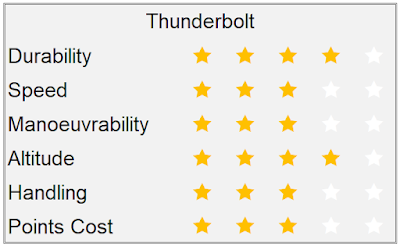

The Thunderbolt (23 pts) and its sister aircraft, the Thunderbolt Fury (25 pts), are the Imperial Navy’s primary fighters. They are durable aircraft with excellent firepower, particularly at medium range. Statistically, the Thunderbolt Fury (averaging 2.23 damage per turn at medium range) is the highest damage-dealing fighter in the game, with the standard Thunderbolt (averaging 1.67 damage per turn at medium range) ranking third.
The principal weaknesses of these aircraft are their speed and manoeuvrability. While both characteristics are still respectable for fighter aircraft in Aeronautica, they can be outmanoeuvred by more agile opponents. In a dogfight, however, the Thunderbolt can rely on its superior firepower and durability to win the day.
Both the Thunderbolt and the Thunderbolt Fury can carry two hardpoints’ worth of ordnance. Skystrike Missiles can be taken to enhance aerial firepower, while Hellstrike Missiles and/or bombs allow them to threaten ground targets. These upgrades increase the cost of the aircraft but also expand their battlefield flexibility.
Any Imperial Navy force should contain a solid core of Thunderbolts and Thunderbolt Furys. In my opinion, they are among the best fighter aircraft in the game.
Lightning


The Lightning is an unusual aircraft. As a fighter, it is significantly inferior to the Thunderbolt and the Avenger due to its low sustained damage output. It is, however, much faster and more manoeuvrable. So what is the purpose of this aircraft?
The Lightning’s high speed, throttle, and manoeuvrability allow it to move easily into the “perfect” position within the Area of Engagement. These same traits also make its movement difficult to predict, which is a considerable advantage in such a strategic game.
Unfortunately, once in position, the Lightning lacks punch. At all ranges, whether armed with Twin Lascannons or Multilasers, its base damage output is underwhelming.
The true strength of the Lightning lies in its three ordnance hardpoints. At an initial cost of 19 points (with Twin Lascannons), it can carry three pairs of missiles for the same cost as a Thunderbolt Fury. All three pairs can be fired in a single firing phase. A Lightning armed with three pairs of Skystrike Missiles and Twin Lascannons can therefore produce an average of 2.35 damage at medium range or 2.01 damage at long range in a single phase.
Alternatively, it can be loaded with Hellstrike Missiles for ground attack. With three pairs of Hellstrikes, the Lightning can often eliminate a ground defence in a single round and still have ordnance remaining.
The Lightning can be configured as a powerful “one-shot” weapon. Used early in the game, it can significantly swing momentum in the Imperial Navy’s favour. However, it is not a substitute for the Thunderbolt.
Avenger Strike Fighter


The Avenger Strike Fighter is an impressive-looking aircraft. It is armed with a toned-down version of the Avenger Bolt Cannon found on the Thunderbolt Fury and can be upgraded with additional Twin Lascannons or Twin Autocannons (I always choose the Lascannons). Together, the Bolt Cannon and Twin Lascannons allow the Avenger to deal an average of 1.78 damage per turn at medium range, making it the second-highest damage-dealing aircraft in the game — though still below the Thunderbolt Fury.
The Avenger ranks just behind the Fury in durability, with 2 Structure points. It has a maximum altitude of 4 (compared to the Fury’s 5), the same maximum speed and manoeuvrability, but a lower throttle. In a direct comparison, the Thunderbolt Fury at 25 points is a stronger aircraft than the Avenger with Twin Lascannons at 23 points.
However, Aeronautica scenarios vary. The Avenger’s key advantage over the Thunderbolt is its Handling value. The Avenger handles on a 2+, while the Thunderbolt handles on a 3+. In low-altitude scenarios, this difference is crucial. The Avenger has only a 1/6 chance of failing a handling test, while the Thunderbolt fails 1/3 of the time. When crashing into terrain destroys the aircraft outright, Structure points become irrelevant.
That is the true role of the Avenger. In open skies, the Thunderbolt remains superior. In terrain-heavy, low-altitude games, the Avenger comes into its own.
Valkyries and Vendettas


Although classed as Fighters, the Valkyrie and Vendetta primarily function as transport craft.
They are armed with a Lascannon, which can be upgraded to a Twin Lascannon or Multi-laser. They may also take a pair of Skystrike Missiles, twin Rocket Pods, or an additional set of Twin-linked Lascannons. A fully upgraded Vendetta can average 2.00 damage per firing phase at medium range (though it has no short-range firepower), which is respectable for 21 points.
Despite this, they are not true dogfighters. Their low maximum speed and limited manoeuvrability make them vulnerable in air-to-air combat.
Where they excel is in transport missions. With 3 Structure points, Transport (3), and the Jump Troops special rule, they are extremely effective at deploying troops. Combined with a Minimum Speed of 0, they can deliver troops to a landing zone without landing, arguably making them the best transport aircraft in the game.
They are a fantastic addition in transport scenarios, though true fighters can easily outmanoeuvre and destroy them in open combat.
Fielding a pure Adeptus Militarum air wing of Valkyries and Vendettas would make for a very different — and cinematic — dogfight. I have tried it and it is a lot of fun.
Vultures

The Vulture is not the fastest aircraft in the game, but it has Throttle 2, a maximum speed of 5, access to all 8 Ace Manoeuvres, and the Jink ability. This makes it one of the most manoeuvrable aircraft available.
It begins with a Heavy Bolter [2/1/0 5+], which is underwhelming. However, it can be upgraded with Punisher Cannons [6/10/0 5+] or two Twin Rocket Pods [2/6/2 5+] with 3 ammo (providing sustained medium-range fire for three turns).
Alternatively, it may take missile or bomb cradles (3 ammo each), allowing it to fire two Hellstrike or Skystrike missiles per turn for three turns. Each turn it rolls four missile dice, damaging on a 3+ with the chance of additional damage on a 6+. This averages approximately 0.9 damage per missile, with a lucky hit capable of inflicting 2 damage — enough to cripple most fighters in a single volley.
In low-altitude games, especially when missile-equipped, the Vulture is a formidable attack craft. In clear skies, its lower speed may limit its impact, though its manoeuvrability helps it avoid danger.
Marauder


The Marauder Bomber costs the same as a Thunderbolt Fury but fulfils a completely different role.
It has 5 Structure points, a maximum speed of 5, and access to 3 Ace Manoeuvres. It will not evade enemy fighters; instead, it relies on durability and friendly escorts to complete its bombing runs.
Offensively, it carries:
-
Forward Lascannons [0/2/1 2+ (6+)]
-
Three Bomb Bay bombs [8/0/0 2+ (5+)]
Defensively, it mounts:
-
A Rear Turret [3/2/0 5+]
-
A Dorsal Turret [3/2/0 5+]
It also has four additional weapon slots for missiles or bombs. A common tactic is to fire Hellstrike Missiles at long range to eliminate ground defences before flying over the primary target and releasing the bomb bay.
Marauder Destroyer

Arvus

The Arvus Lighter is an unarmed transport aircraft used exclusively in scenarios requiring Transport capacity.
It has the Valuable Cargo special rule, allowing it to disengage after deploying troops and thereby deny the opponent victory points.
Its low points cost makes it tactically interesting. It forces opponents to choose between targeting the Arvus to disrupt the mission or focusing on enemy fighters. Additionally, its cheap cost can help the Imperial player influence initiative order.
It is scenario-specific but effective when used correctly.
Hydra Flak Battery

Profile: [6/4/2 5+]
Effective altitude: 2
The Hydra excels in low-altitude engagements and in protecting specific ground targets. However, opponents can avoid it by flying at altitude 4 or 5.
It is particularly strong when enemies lack bombs and must commit to strafing runs.
Manticore Missile Battery

Effective altitude: 5
Profile: [2/1/1 4+ (5+)]
The Manticore is more flexible than the Hydra in scenarios without fixed ground targets. It threatens aircraft at all altitudes and is most effective at short range.
If you have spare points and the scenario permits ground defences, the Manticore is an excellent choice. Plus, it looks cool.
Basilisk Anti-Aircraft Emplacement
Effective altitude: 4
Profile: [1/2/1 2+ (6+)]
The Basilisk is a straightforward, reliable air defence platform. It is not flashy, but it provides consistent long-range threat coverage — exactly what you would expect from the Imperium.
Conclusion
In conclusion, the Imperial Navy offers the most complete and versatile force in Aeronautica Imperialis. With a wide range of aircraft, flexible weapon options, and strong performance at medium range, it is capable of adapting to almost any scenario. Whether you favour durable dogfighters, precision strike craft, dedicated bombers, or transport-focused missions, the Navy has the tools to compete. Even in a discontinued system, it remains one of the most accessible and rewarding factions to collect and play, perfect for beginners and veterans alike.
One of its greatest strengths from a collector’s perspective is that a well-chosen range of aircraft can be reorganised into multiple different “lists.” A core of Thunderbolts can anchor an air superiority wing, Lightnings can provide early alpha-strike pressure, Marauders enable ground-attack missions, and Valkyries or Arvus Lighters open up transport-focused scenarios. With a relatively modest collection, you can field forces tailored to dogfights, low-altitude terrain runs, strategic bombing operations, or troop insertion missions. This flexibility allows you to experience the full range of missions that Aeronautica Imperialis has to offer without needing to invest in multiple factions.
For players looking to explore everything the game can do, the Imperial Navy remains the most complete and adaptable force available.
Related Articles
If you're enjoying the content, feel free to hit that follow button at the top of the page. It really helps and keeps you updated!
No matter which aircraft you choose or how you build your force, remember that the skies are a dangerous place. Strategy, positioning, and quick thinking are key to survival. So, gear up, plan your moves carefully, and always watch your six—because in Aeronautica Imperialis, the enemy is never far behind.


Comments
Post a Comment